
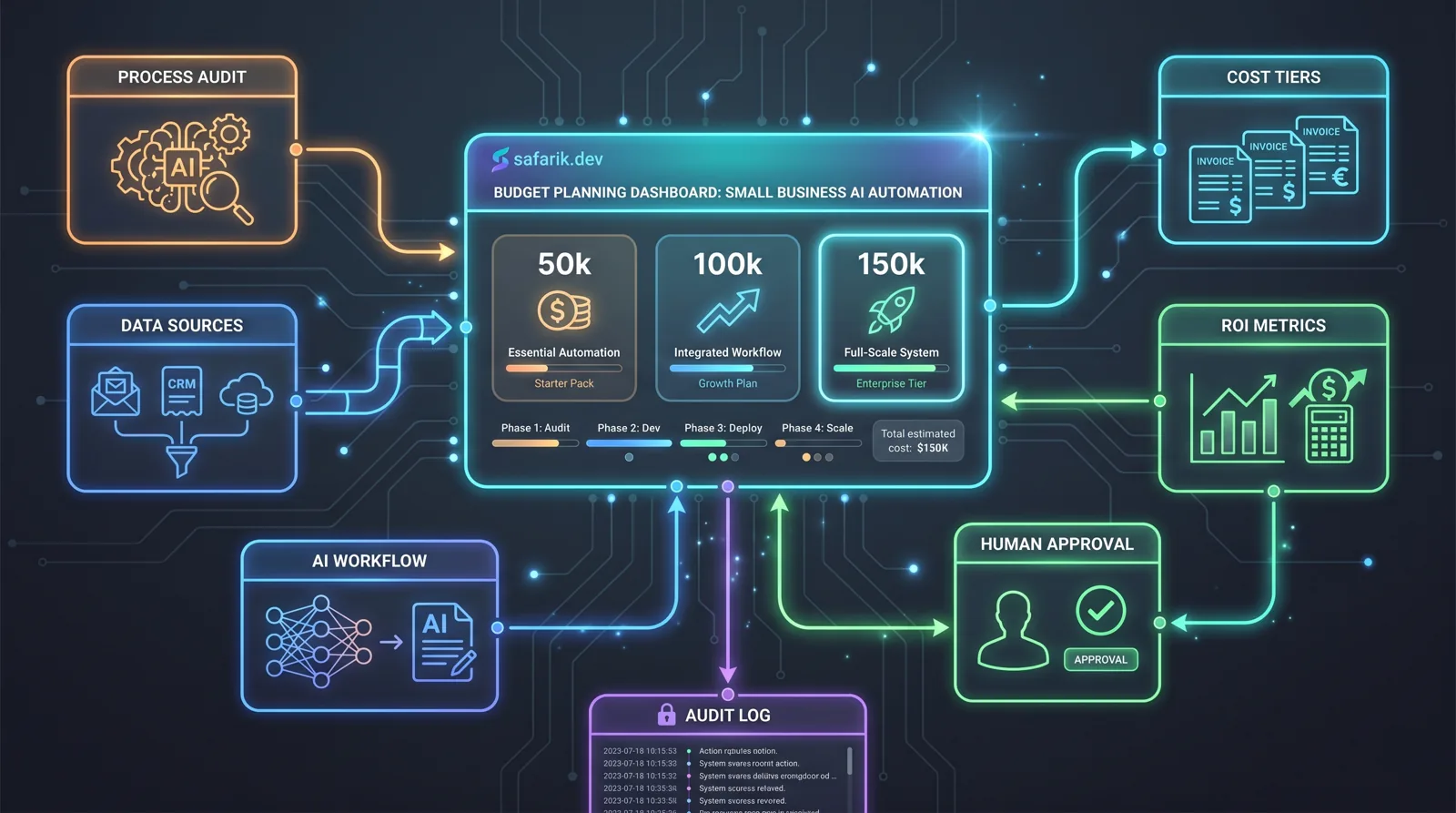
How much a small business AI automation costs
A practical budget guide for a first business AI automation: what fits into CZK 50–150k, where to save, and where not to cut corners.

Vít Šafařík
AI & business productivity
Business owners rarely start with: “Which model should we use?” The better question is simpler: “How much will the first sensible AI automation cost, and how will we know it was not just a toy?”
That is the right question. For small and mid-sized companies, it usually makes little sense to begin with a six-month transformation programme. A better approach is to choose one specific process, build a narrow first version, and measure after a few weeks whether it saves time, reduces errors, or improves decision-making.
A budget of CZK 50–150k is not enough for an “AI strategy for the whole company”. But it is enough for a well-scoped automation that works with real data, includes human control, and does not remain a prototype in a chat window.
Why budget comes before technology
McKinsey’s 2025 global AI survey describes rapid growth in AI and generative AI adoption, but it also notes that most organisations still do not see measurable enterprise-level bottom-line impact. The important detail: value does not come from using an AI tool by itself. It comes from redesigning workflows, governance, and measurement.
For a smaller company, the lesson is practical: the most expensive mistake is not choosing a model that is slightly worse. The real problem is paying for a solution without a clear owner, input data, exception rules, and a definition of success.
Setting the budget early forces three uncomfortable questions:
- Which process repeats often enough?
- Where do we actually lose time or create operational risk today?
- What must be included in the first version, and what can wait?
Without those answers, an AI project easily expands. A chatbot, dashboard, integrations, notifications, a knowledge base, reporting — and suddenly nobody knows what was supposed to pay back the investment.
What usually fits into CZK 50–150k
Think of this as a budget for a first production version, not an endless experiment. In practice, it can cover one narrow scenario such as:
- automatic processing of incoming emails or forms,
- data extraction from orders, requests, invoices, or service reports,
- an internal AI assistant over company documents,
- draft replies for customer support with human approval,
- a simple dashboard combining spreadsheet, CRM, and operational data,
- an approval workflow where AI prepares the inputs and a person makes the decision.
The project must be tightly scoped. For example: “AI reads an incoming request, extracts the job type, deadline, location, and risk notes, creates a CRM record, and drafts a reply.” Not: “AI will solve sales for us.”
A practical breakdown of the work
In a small automation project, the budget usually goes into five areas:
- Process and data audit — understanding the current workflow, volume, exceptions, sources, and risks.
- Workflow design — deciding what AI does, what deterministic logic does, and what stays with a human.
- Integrations — connecting email, spreadsheets, CRM, helpdesk, accounting, or an internal database.
- Testing on real cases — checking historical inputs, finding failure modes, and setting guardrails.
- Deployment and measurement — handing over the workflow, dashboard or logs, and agreeing on operational review.
“Prompting” is only a small part. The value is in making the solution fit operations and behave safely when an unexpected input arrives.
Where saving money makes sense
You can save by limiting the scope of the first version. I would not start with all branches, all customer segments, or all document types. Pick one branch of a process with high repetition and relatively few critical exceptions.
Example: instead of “automate the whole accounting department”, start with incoming supplier invoices from one email inbox. AI extracts the supplier, amount, variable symbol, due date, and cost centre. A person approves exceptions, and the system keeps an audit trail. That is concrete, measurable, and expandable.
It also makes sense to use existing tools. If the company already works in Google Workspace, Microsoft 365, Airtable, Notion, Pipedrive, Raynet, Fakturoid, SuperFaktura, HelpScout, or Zendesk, you often do not need to build a custom app from scratch. The useful work is connecting data, rules, and the AI layer.
Where I would not cut corners
I would not cut corners on checking input data. IBM’s explainer on AI hallucinations is a useful reminder that generative AI can produce inaccurate or misleading outputs. In a business process, the rule is simple: AI must not make decisions based on sources nobody trusts.
I would also avoid cutting human approval from expensive or sensitive steps. The EU AI Act uses a risk-based approach and, for high-risk systems, emphasises risk management, transparency, and human oversight. Most small internal automations will not fall into the strictest category, but the design principle is still useful: the greater the impact of a mistake, the clearer the control point must be.
And I would not skip logging. If an automation sends an email, changes a CRM status, or prepares billing inputs, it must be possible to see what happened, from which data, and who approved it.
A simple frame: CZK 50k, 100k, and 150k
Every company is different, but a rough frame helps decision-making.
CZK 50k: a narrow pilot with manual control
Good for first validation. One process, one data source, one output. For example, AI classifies incoming requests and drafts a reply that a person reviews.
Goal: find out whether the data is usable, how often AI fails, and how much time can realistically be saved. I would not promise full automation here. Think of it as a well-designed assistant.
CZK 100k: first operational automation
This can include one or two system integrations, a basic dashboard or log view, and clear escalation rules. The automation may handle routine cases by itself, while preparing context for a human when there is an exception.
Goal: reduce manual work in one specific process and start measuring results: processed cases, time per case, returned errors, and escalations.
CZK 150k: a more robust workflow with measurement
This can include more integrations, a better test set, user roles, an audit trail, and operational handover. It is still not a large enterprise project. But it can be a solid first version of an internal tool that runs every day.
Goal: build something that can be extended later, not a one-off script only the original builder understands.
How to know the investment is paying back
I would not calculate ROI using invented claims such as “AI will increase productivity by 40%”. For small automations, simpler maths is enough:
- how many cases the process handles per week,
- how many minutes one case takes today,
- how many minutes it takes after deployment,
- how many errors or rework loops disappear,
- what faster response means for customers or sales.
If a team processes 300 similar inputs per month and each takes 8 minutes, that is 40 hours of work. If automation safely saves half of that, you get roughly 20 hours per month back. That is not a universal ROI promise. It is a way for each company to plug in its own volume, wages, and value of time.
The NIST AI Risk Management Framework recommends treating AI risk across the system lifecycle: governance, mapping impacts, measurement, and management. Translated into a smaller company: “it worked in the demo” is not enough. You need to know where it can fail, how you will measure it, and who will keep it healthy.
When to wait
I would wait if:
- the process has no owner,
- rules change depending on mood or customer,
- data is broken and nobody trusts it,
- the company cannot define a good or bad output,
- a mistake could create legal, financial, or reputational damage and there is no human oversight ready.
In that situation, the first step is not development. The first step is cleaning up the process, writing down rules, and choosing a safe use case.
What I would do first
List five candidates for automation and answer these questions for each:
- how many cases per week do we handle,
- who handles them today,
- which systems and data are needed,
- what are the most common exceptions,
- what would AI be allowed to do alone,
- what must a person approve,
- how will we know after 30 days that it worked?
That usually makes it clear whether CZK 50k, 100k, or 150k is the right first budget. More importantly, it shows whether the company has a real problem prepared — or just a vague desire to “do something with AI”.
If your company has a process that repeats every week and costs people time, I would start with an AI audit. We will choose the use case, estimate the realistic first version, and decide what to automate now, what to keep with humans, and what not to build yet.
Share this article
Found this article helpful? Share it with colleagues who might benefit.